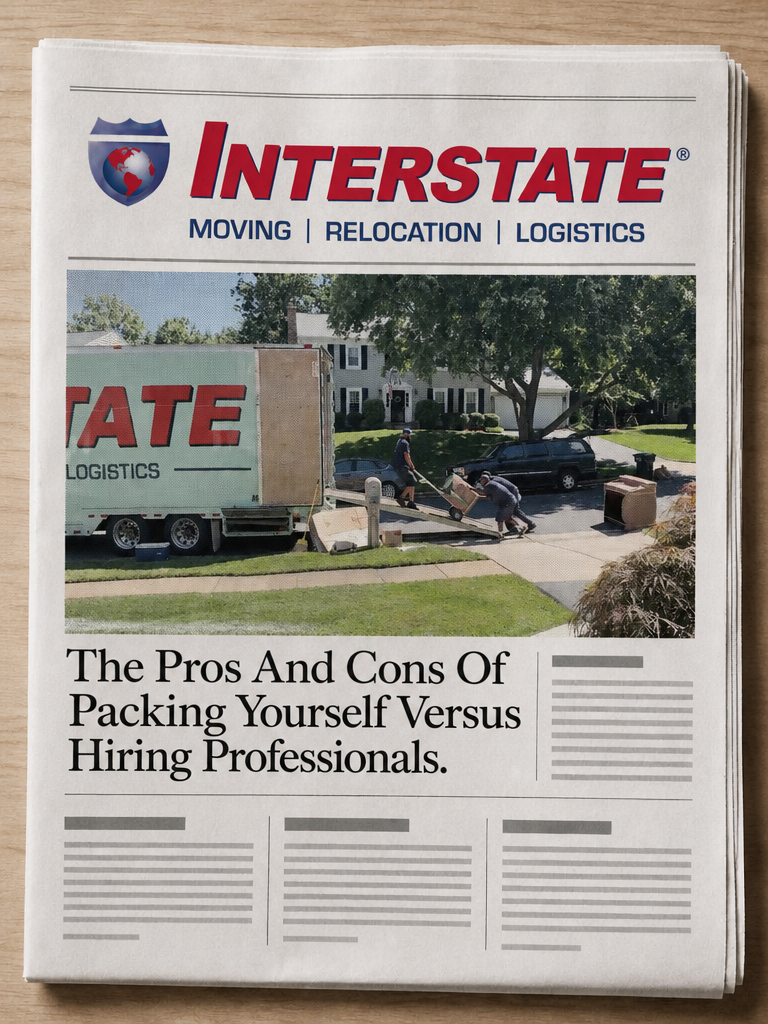
The Pros and Cons of Packing Yourself Versus Professional Packing
Is packing yourself really worth the savings, or will you end up paying for it later in damage and delays? Should you spend your weekend wrapping dishes in newspaper, or let the movers handle it for you? This is a decision almost every family faces before a move, and it can have a big impact on your budget, your stress level, and the condition of your belongings when they arrive.
I’m Larry Miller, a member of the sales team here at Interstate Moving | Relocation | Logistics. Over the years I have walked through hundreds of homes and conducted just as many virtual surveys. I have seen both approaches work beautifully, and I have also seen them go wrong in costly ways. Some run smoothly because the packing was done with care. Others run over budget because the wrong things were packed the wrong way.
It is not as simple as saying that packing yourself saves money or that professional packing is too expensive. There are real cost, time, and risk factors in both approaches. Understanding them before you tape the first box can make the difference between a move that goes according to plan and one that turns into a stressful, expensive surprise.
Packing Yourself vs. Professional Packing — Quick Comparison
| Factor | Packing Yourself | Professional Packing |
|---|---|---|
| Upfront Cost | Lower labor cost because you’re doing the work. | Higher labor cost for packing time. |
| Valuation Coverage | On a box you packed and sealed, we have liability only if the box arrives visibly damaged and that is documented at delivery. | Items we pack are covered at whichever valuation level you signed for, released or full. |
| Time on Move Day | Risk of delays if not fully packed — can raise labor charges. | Faster loading; movers can handle about 500 lbs/hour in standard homes. |
| Packing Quality | Depends on your skill and materials; higher risk if not done to professional standards. | Professional techniques and materials reduce damage risk. |
| Flexibility | Pack on your own schedule, weeks in advance. | Packing is done in a set timeframe before move day. |
| Effort | High — requires time, energy, and supplies. | Low — movers do all the packing for you. |
| Best For | Clothes, linens, books, and other non-breakables. | Fragile items, electronics, mirrors, artwork, dishes, and valuables. |
Why the Decision Is Not Always Clear
While a quick glance might make the pros and cons seem obvious, the real choice depends on what you are moving, how much time you have, and how comfortable you are with risk. Packing yourself can save hundreds of dollars in labor, but if a single piece of furniture or a box of glassware gets damaged, those savings can disappear instantly. Hiring professionals for everything is the safer choice in terms of protection and efficiency, but you might end up paying for services you could have handled just as well on your own.
One of the biggest factors I see affecting the cost is how efficiently the crew can load the truck. In an ideal setup, movers can load about 500 pounds of goods per hour. That efficiency drops to 350 or 400 pounds per hour if boxes are poorly packed, open, or unstable, or if items need to be rewrapped for safety. Every hour of extra labor adds directly to your bill, and those hours can add up quickly. I have been on moves where the difference between a well-prepared home and a poorly packed one added several hundred dollars to the final invoice.
When Professional Packing Makes Sense
If you own fragile, high-value, or awkwardly shaped items, professional packing is almost always worth it. Movers bring the right materials and the right techniques to protect delicate items like glassware, artwork, mirrors, and electronics.
What Valuation Coverage Is, and Why It Is Not Insurance
There is a coverage difference as well, and it is the part customers most often misunderstand. We are not an insurance company, and legally we cannot provide insurance. What we provide is valuation coverage, which is the level of liability we accept for your shipment while it is in our possession.
You choose that level, and it is worth understanding what you are agreeing to when you sign your paperwork at the time of sale. Released valuation is the legal minimum every moving company has to offer, and it covers 60 cents per pound. A picture frame weighing a pound is covered for 60 cents. Full valuation coverage is written at a higher rate, commonly somewhere between $6 and $8 per pound depending on what you sign, so at $8 per pound that same one-pound frame is covered for $8.
How a claim settles depends on the damage. If an item is destroyed outright, we go to the marketplace for like kind. If only part of it is damaged, say the glass is cracked but the frame itself is sound, the settlement reflects that. If your agreement carries a deductible, you cover the first part of a claim and the claims process picks up beyond it.
What This Means for Boxes You Pack Yourself
When you pack and seal a box yourself, we have no way of knowing what went into it or how well it was packed. The only circumstance where we would have liability on a packed-by-owner box is if there is visible damage to the box when it comes off the truck at destination.
If that happens, photograph the box, note the inventory number, and open it with the crew present to check the contents. Without that documented damage, most agents and van lines will deny a claim on a customer-packed carton, and reasonably so. A dented corner with everything intact inside is not a claim. Damage inside a box that arrived sound usually traces back to how it was packed.
When our crew packs a carton, that question does not come up. The box is covered at whichever valuation level you signed for.
What Valuation Coverage Does Not Include
A few things sit outside valuation coverage regardless of the level you choose. Sets and pairs, acts of God, and mechanical or inherent vice are the usual ones, along with anything that was not permitted to travel in the first place. Pack an ink cartridge against advice and it leaks across a carton, and that is not a claim.
One more worth raising before you move. If you are counting on your homeowners policy to cover the gap, read it first. Most policies cover household goods in the residence rather than in transit, and most will not augment for a single high-value item. People tend to assume their coverage follows the goods onto the truck, and it usually does not.
Professional packing also speeds up move day. When my team packs everything, we know exactly how each box is stacked and secured, which makes loading more efficient. We can often complete the load in less time, which helps control labor costs even if the upfront packing fee is higher.
When Packing Yourself Can Work
Packing yourself can be the right choice if you have the time, energy, and materials to do it well. Sturdy, non-breakable items like clothing, linens, and books are usually safe to pack on your own. You can start weeks ahead, work on your own schedule, and spread the effort out instead of cramming it all into the days before the move.
However, the quality of your packing matters. If boxes are underfilled, overfilled, or lack proper cushioning, they can collapse or shift in transit, leading to damage. Even if nothing breaks, the crew might need to spend extra time fixing or repacking boxes before loading them. That extra time can erase the savings you hoped to get by doing it yourself.
Why Mixing Both Approaches Can Be the Smartest Move
For many people, a hybrid strategy delivers the best results. I often recommend letting the movers pack the fragile, high-value, and hard-to-pack items, while you handle the easy, low-risk belongings yourself. That way you save on labor without sacrificing protection for the things that matter most. TVs, mirrors, artwork – if it can break easily, let us pack it. You focus on clothes and books.
One piece of advice I always give is this: if you do not love it, do not take it. If it costs more to ship than replace, leave it behind. Following that rule not only reduces your load but also makes packing simpler and faster, whichever method you choose.
Pros and Cons at a Glance
Packing Yourself
Pros:
- Lower labor cost because you only pay for moving.
- Flexible timing that lets you work on your own schedule.
- Full control over how your belongings are packed.
Cons:
- On a box you packed and sealed, we have liability only if the box arrives visibly damaged and that is documented at delivery.
- Higher risk of damage if packing is not done to professional standards.
- Can slow down move day if boxes are not ready or stable, adding to labor costs.
Professional Packing
Pros:
- Items we pack are covered at whichever valuation level you signed for.
- Faster loading with a consistent, professional process.
- Reduced risk of damage thanks to expert techniques and materials.
Cons:
- Higher upfront cost for labor.
- Packing is scheduled close to move day, so there is less flexibility.
The Bottom Line
Packing yourself can work well if you know what you are doing, you have the right supplies, and you give yourself plenty of time. Professional packing takes the work off your plate and offers maximum protection, but you will pay more upfront. Most people find the sweet spot somewhere in the middle. The key is to be strategic: know where you can save and where it is worth spending to protect your belongings and keep the move on schedule.
If you are not sure which approach makes sense for your move, schedule a free in-home or virtual survey. We will walk you through the costs for each option, explain how your choices affect the final bill, and help you build a plan that fits your budget and your priorities.