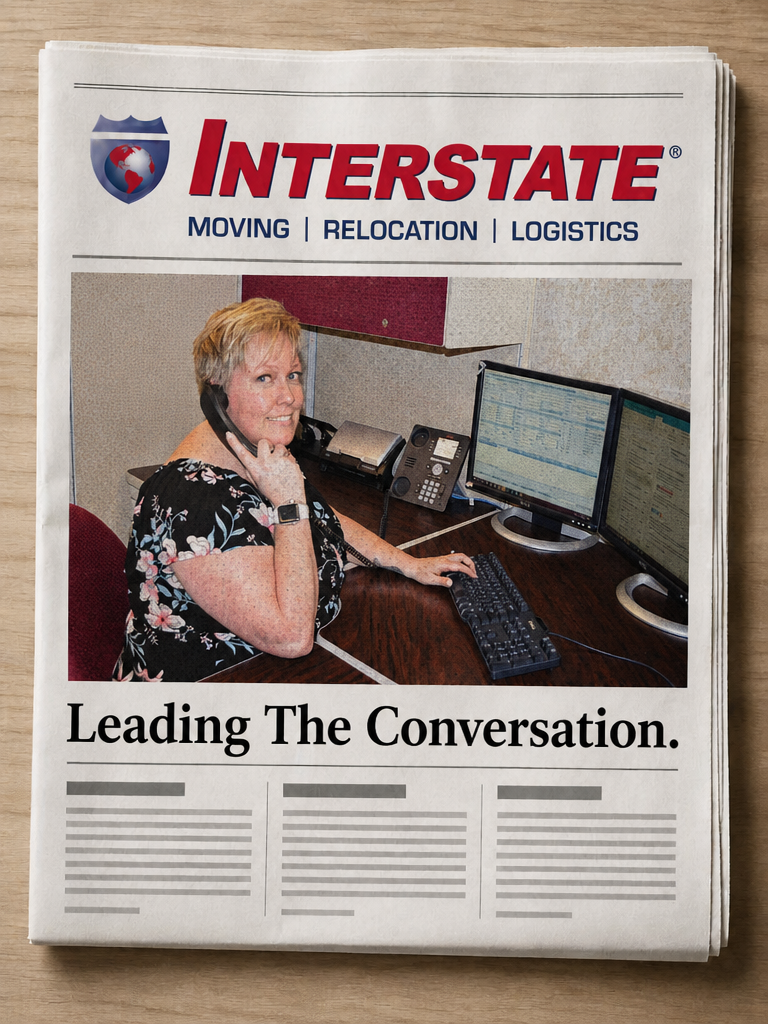
Leading the Conversation
Leading the Conversation: Interstate Experts in the National Press
For more than eighty years, Interstate Moving | Relocation | Logistics has done the work that keeps people and businesses moving. What that work teaches, over decades and across more than a hundred countries, is hard to find anywhere else. It is the kind of operating knowledge that publications come looking for when they want to explain how their corner of the economy actually functions.
That is what has happened over recent months. Three Interstate professionals have appeared in three respected publications, each speaking to a different part of the business and a different conversation shaping the wider industry. Forbes turned to Interstate to explain the economics of moving high-value, specialty items. The Inside Lane sat down with one of Interstate's drivers to talk about the realities facing the people behind the wheel. fDi Intelligence drew on Interstate's global perspective to make sense of how the worldwide build-out of data centers is redirecting investment and trade. Three publications, three pillars of the company, and a single through-line. When the industry needs an authority, it increasingly finds one within Interstate.
Forbes: the real economics of a specialty move
Some items do not fit the standard moving playbook, and the piano is the example everyone understands. It is heavy, delicate, expensive, and unforgiving of a single wrong move. That combination is exactly why Forbes Home built a guide around what it costs to move one, and why the publication wanted an industry voice that handles these jobs in the real world rather than in theory.
Hugo Mercedes, Interstate's Director of Sales, brought that perspective to the piece. The article walks readers through the factors that actually drive the price of a specialty move: the size and type of the instrument, the stairs and tight turns between the piano and the truck, the custom crating that protects a finish or a soundboard, the equipment needed when an item has to clear a window or a balcony, and the distance it ultimately travels. For anyone who has only ever priced a move by the box, it is a useful look at why specialty handling sits in a category of its own.
It is also a window into how Interstate approaches this work every day. The same discipline the Forbes article describes for pianos applies to the fine art, antiques, laboratory and medical equipment, and other high-value goods that Interstate's teams pack, move, and sometimes store. The principle is consistent. Assess the item before you quote the job, match the crating and equipment to the risk, and price the protection that the asset actually requires.
“Access is a big cost factor… Is the piano on the first or second floor? Does it need to go up or down narrow stairs? Will it fit through the doorway? Does it need to be hoisted through a window or balcony? A proper estimate should account for the safest way to move the instrument, not just the quickest or cheapest way.” – Hugo Mercedes
Read the Forbes guide: What it costs to move a piano
The Inside Lane: the conversation drivers are actually having
Most coverage of the trucking workforce happens at thirty thousand feet, in statistics about shortages and turnover. The Inside Lane, a publication read across the freight and trucking community, took a different route. It went to a working driver.
Mihai David is one of Interstate's drivers, recognized by the company for his exceptional safe-driving record.. In his conversation with The Inside Lane, he describes the pressures of life on the road, what keeps experienced drivers in the profession, the conditions that push others out, and the regulatory changes reshaping who is qualified to drive.
Mihai’s perspective reflects the manner in which Interstate thinks about its fleet. Drivers like Mihai are the company's front line, the people who carry more than a billion dollars in customer goods each year and who represent Interstate at the curb on the most important day of a customer's move. Interstate's investment in driver safety, training, and retention is the reason a driver can speak with that kind of authority, and the reason the work holds up when it matters.
“Most independent drivers are also paying off their equipment. I'd estimate around 90% are financing their trucks.” – Mihai David
Read the interview: Mihai David in The Inside Lane
fDi Intelligence: how data centers are redrawing global trade
The largest story in global investment right now is being built of concrete and servers. Data centers have become one of the biggest destinations for cross-border capital in the world, and that surge is reshaping where companies expand and how goods and equipment move across borders. fDi Intelligence, the Financial Times publication that tracks foreign direct investment, examined what that shift means for trade. Interstate's global perspective informed the discussion.
Ruth Moritz, Senior Vice President and General Manager of Global Relocation, leads Interstate's International and Relocation Services business and brings deep experience in global shipping and freight forwarding. That vantage point connects directly to the article's subject. When investment of this scale lands in a new market, it sets off a chain of physical work: site selection, commercial build-outs, the specialized logistics of moving IT and data center infrastructure, and the relocation of the teams who run the new facilities. Reading about where the capital is heading is a way of anticipating where the moves will follow.
The connection is not abstract for Interstate. Information technology and data center relocation is an established part of the company's logistics services, alongside global relocation, freight forwarding, and supply chain solutions that reach more than a hundred countries. The trends fDi Intelligence describes at the level of global capital are the same trends Interstate plans around at the level of individual shipments.
“A lot of “creative solutions” are being used to import data centre equipment into the US.” – Ruth Moritz
Read the analysis: fDi Intelligence on data centers and trade
One company, three conversations
Specialty moving, the driver workforce, and the global investment flows reshaping logistics can look like three separate stories. For Interstate, they are three sides of one business and one standard. The expertise is real because the work is real, built over eight decades of moving and managing logistics for businesses and families.
That is what industry leadership looks like in practice. It is the company's people, across Moving, Relocation, and Logistics, being recognized by the publications that shape their fields as the experts worth quoting. The conversations defining this industry are happening in the national and trade press, and Interstate's voices are helping to lead them.
For more than eighty years, Interstate Moving | Relocation | Logistics has done the work that keeps people and businesses moving. What that work teaches, over decades and across more than a hundred countries, is hard to find anywhere else. It is the kind of operating knowledge that publications come looking for when they want to explain how their corner of the economy actually functions.
That is what has happened over recent months. Three Interstate professionals have appeared in three respected publications, each speaking to a different part of the business and a different conversation shaping the wider industry. Forbes turned to Interstate to explain the economics of moving high-value, specialty items. The Inside Lane sat down with one of Interstate's drivers to talk about the realities facing the people behind the wheel. fDi Intelligence drew on Interstate's global perspective to make sense of how the worldwide build-out of data centers is redirecting investment and trade. Three publications, three pillars of the company, and a single through-line. When the industry needs an authority, it increasingly finds one within Interstate.
Forbes: the real economics of a specialty move
Some items do not fit the standard moving playbook, and the piano is the example everyone understands. It is heavy, delicate, expensive, and unforgiving of a single wrong move. That combination is exactly why Forbes Home built a guide around what it costs to move one, and why the publication wanted an industry voice that handles these jobs in the real world rather than in theory.
Hugo Mercedes, Interstate's Director of Sales, brought that perspective to the piece. The article walks readers through the factors that actually drive the price of a specialty move: the size and type of the instrument, the stairs and tight turns between the piano and the truck, the custom crating that protects a finish or a soundboard, the equipment needed when an item has to clear a window or a balcony, and the distance it ultimately travels. For anyone who has only ever priced a move by the box, it is a useful look at why specialty handling sits in a category of its own.
It is also a window into how Interstate approaches this work every day. The same discipline the Forbes article describes for pianos applies to the fine art, antiques, laboratory and medical equipment, and other high-value goods that Interstate's teams pack, move, and sometimes store. The principle is consistent. Assess the item before you quote the job, match the crating and equipment to the risk, and price the protection that the asset actually requires.
“Access is a big cost factor… Is the piano on the first or second floor? Does it need to go up or down narrow stairs? Will it fit through the doorway? Does it need to be hoisted through a window or balcony? A proper estimate should account for the safest way to move the instrument, not just the quickest or cheapest way.” – Hugo Mercedes
Read the Forbes guide: What it costs to move a piano
The Inside Lane: the conversation drivers are actually having
Most coverage of the trucking workforce happens at thirty thousand feet, in statistics about shortages and turnover. The Inside Lane, a publication read across the freight and trucking community, took a different route. It went to a working driver.
Mihai David is one of Interstate's drivers, recognized by the company for his exceptional safe-driving record.. In his conversation with The Inside Lane, he describes the pressures of life on the road, what keeps experienced drivers in the profession, the conditions that push others out, and the regulatory changes reshaping who is qualified to drive.
Mihai’s perspective reflects the manner in which Interstate thinks about its fleet. Drivers like Mihai are the company's front line, the people who carry more than a billion dollars in customer goods each year and who represent Interstate at the curb on the most important day of a customer's move. Interstate's investment in driver safety, training, and retention is the reason a driver can speak with that kind of authority, and the reason the work holds up when it matters.
“Most independent drivers are also paying off their equipment. I'd estimate around 90% are financing their trucks.” – Mihai David
Read the interview: Mihai David in The Inside Lane
fDi Intelligence: how data centers are redrawing global trade
The largest story in global investment right now is being built of concrete and servers. Data centers have become one of the biggest destinations for cross-border capital in the world, and that surge is reshaping where companies expand and how goods and equipment move across borders. fDi Intelligence, the Financial Times publication that tracks foreign direct investment, examined what that shift means for trade. Interstate's global perspective informed the discussion.
Ruth Moritz, Senior Vice President and General Manager of Global Relocation, leads Interstate's International and Relocation Services business and brings deep experience in global shipping and freight forwarding. That vantage point connects directly to the article's subject. When investment of this scale lands in a new market, it sets off a chain of physical work: site selection, commercial build-outs, the specialized logistics of moving IT and data center infrastructure, and the relocation of the teams who run the new facilities. Reading about where the capital is heading is a way of anticipating where the moves will follow.
The connection is not abstract for Interstate. Information technology and data center relocation is an established part of the company's logistics services, alongside global relocation, freight forwarding, and supply chain solutions that reach more than a hundred countries. The trends fDi Intelligence describes at the level of global capital are the same trends Interstate plans around at the level of individual shipments.
“A lot of “creative solutions” are being used to import data centre equipment into the US.” – Ruth Moritz
Read the analysis: fDi Intelligence on data centers and trade
One company, three conversations
Specialty moving, the driver workforce, and the global investment flows reshaping logistics can look like three separate stories. For Interstate, they are three sides of one business and one standard. The expertise is real because the work is real, built over eight decades of moving and managing logistics for businesses and families.
That is what industry leadership looks like in practice. It is the company's people, across Moving, Relocation, and Logistics, being recognized by the publications that shape their fields as the experts worth quoting. The conversations defining this industry are happening in the national and trade press, and Interstate's voices are helping to lead them.
When the industry needs an authority, it increasingly finds one within Interstate.